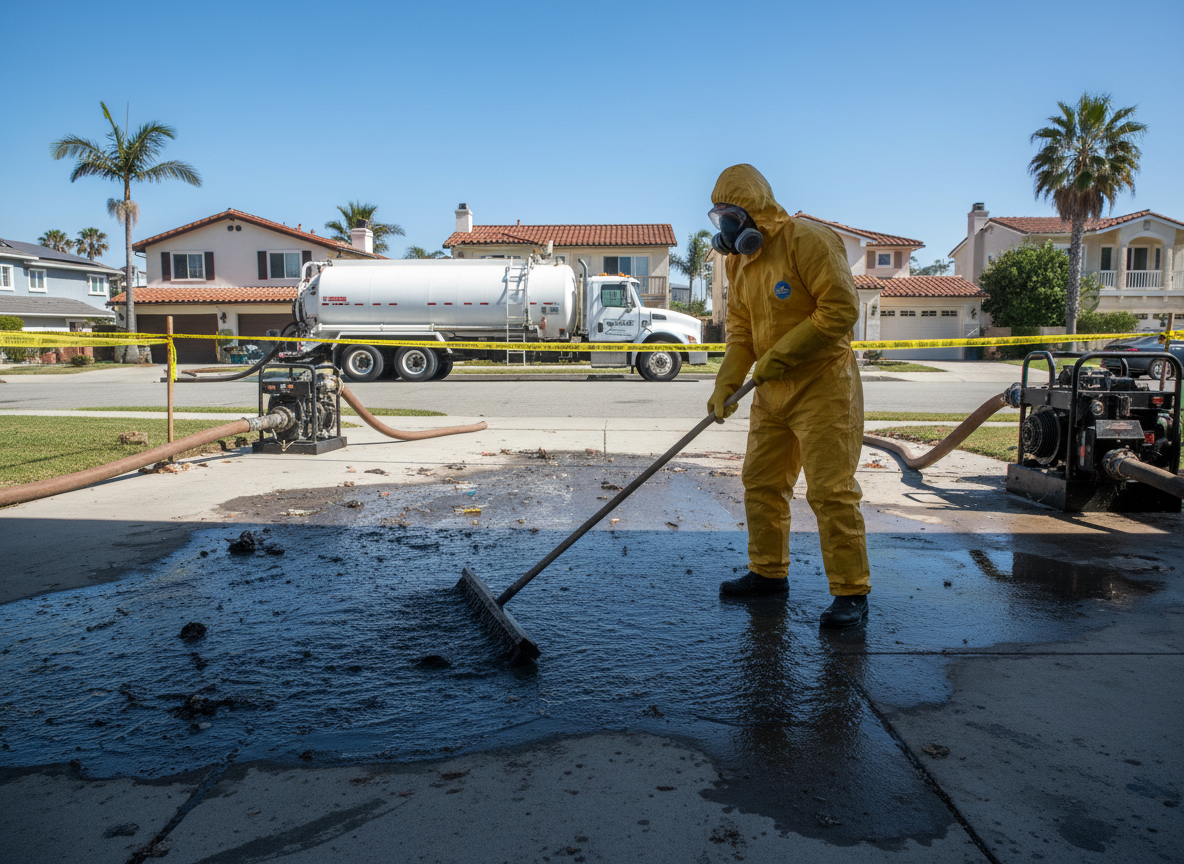
Sewage cleanup in Del Mar requires strict containment because the mild coastal Mediterranean climate still brings occasional intense winter rains that overwhelm older pipes in Del Mar Village homes built before the 1970s. These properties often sit on clay-heavy soils that hold moisture, allowing pathogens to migrate under foundations toward nearby Del Mar Heights lots. Technicians must use negative air machines and antimicrobial agents rated for Category 3 water to prevent cross-contamination into living spaces.
Near the coast, sewage events frequently tie to storm surges at Del Mar Beach or Powerhouse Park that push saltwater mixed with effluent into low-lying North Beach residences. The sandy substrate here drains fast but leaves behind corrosive salts that damage subfloors and framing if not fully extracted. Removal crews cut and dispose of affected drywall at the two-foot line above the water mark, then apply HEPA vacuuming followed by thermal drying to meet San Diego County health standards before any reconstruction begins.
Homeowners in Solana Beach and Encinitas sometimes call after backups travel through shared laterals, but Del Mar jobs demand extra documentation because of the proximity to the racetrack and its aging municipal lines. Every project includes photographic logging of removed materials and air quality readings before clearance, since residual odors travel quickly through the open coastal terrain and affect adjacent properties.
Technician insight
In Del Mar, the thing that catches most people out with sewage cleanup is the sandy soil along North Beach that lets effluent travel laterally into neighboring yards during even moderate winter rains, so we always check adjacent properties before declaring a job complete.
Backup Near Powerhouse Park
A Del Mar Village homeowner discovered sewage rising through a bathroom floor drain after heavy rain. We traced the issue to a cracked lateral line near the park. Crews contained the flow, removed saturated subfloor sections, disinfected the crawl space, and dried the structure over four days to prevent hidden mold in the coastal humidity.
How it works
- 1
Initial Assessment
Technicians arrive within hours, identify the source, test for contaminants, and map moisture migration through the structure.
- 2
Containment And Removal
Set up barriers, extract standing sewage, and safely dispose of saturated porous materials like carpet and drywall.
- 3
Cleaning And Disinfection
Apply EPA-registered antimicrobials, HEPA vacuum surfaces, and treat hard materials to eliminate pathogens.
- 4
Drying And Verification
Deploy commercial drying equipment, monitor humidity levels, and confirm clearance with moisture meters and air sampling.
Pricing
Costs depend on the volume of affected space, depth of contamination, and whether structural materials must be removed; we provide upfront written estimates before work begins.