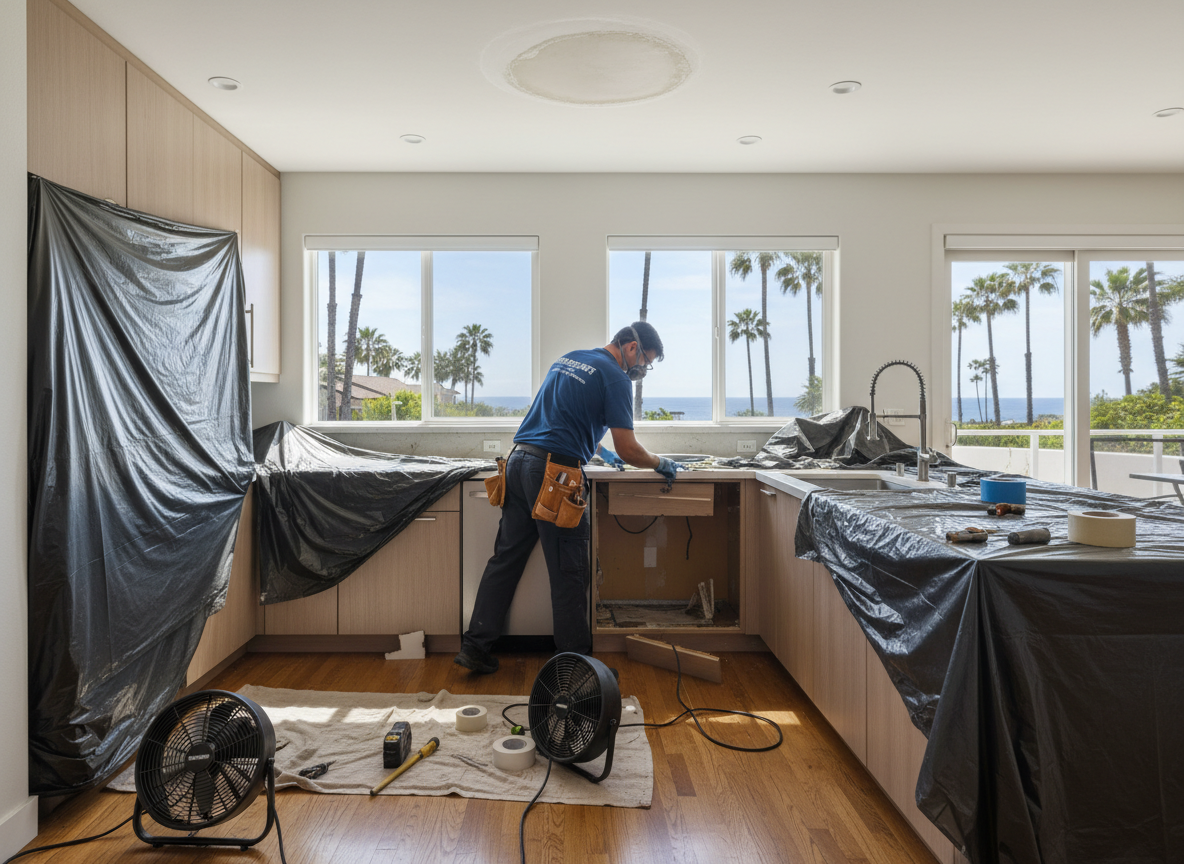
Kitchens in Del Mar Village and North Beach often feature older copper supply lines and particleboard cabinetry that absorb water quickly from dishwasher or sink leaks. The mild coastal Mediterranean climate keeps ambient humidity elevated year-round, slowing natural evaporation and allowing hidden moisture to migrate into subfloors or shared walls with adjacent rooms. Technicians must remove baseboards and toe kicks early to map saturation, then use moisture meters on both hardwood and tile to locate pockets that standard fans miss.
Salt air from Del Mar Beach accelerates corrosion on stainless fittings and P-traps, especially in homes near Powerhouse Park where wind carries additional moisture inland. Edge cases include ice-maker lines behind refrigerators that leak into finished flooring without visible puddling, and under-cabinet leaks that reach load-bearing joists in two-story Del Mar Heights properties. Proper protocol requires negative-pressure containment to protect living spaces while drying proceeds, followed by selective replacement of only the damaged sections rather than full kitchen rip-outs.
San Diego County building standards require permits when structural members or electrical components are involved, so crews document moisture mapping and drying logs for any work that affects load paths or wiring. Homeowners in Encinitas and Solana Beach frequently discover that insurance adjusters request these logs before approving cabinet or flooring repairs, making thorough documentation essential from the first visit.
Technician insight
In Del Mar, the thing that catches most people out with Kitchen water damage repair is salt-laden air from Del Mar Beach speeding corrosion on under-sink fittings in older Del Mar Village homes. Homeowners often stop at visible puddles and miss moisture that has wicked into particleboard toe kicks, allowing hidden mold to form during the mild but persistently humid coastal weather.
Dishwasher Leak in Del Mar Heights
A homeowner in Del Mar Heights noticed water seeping from under the dishwasher after a cycle. Inspection revealed saturated particleboard cabinets and moisture extending into the adjacent hardwood floor. Extraction, targeted drying, and replacement of only the damaged cabinet base and flooring section restored the kitchen without full demolition.
How it works
- 1
Initial Assessment
Technician arrives within hours, maps all wet materials with meters, and identifies the leak source while protecting unaffected areas.
- 2
Water Extraction
Standing water is removed from floors and inside cabinets using portable extractors suited to tight kitchen spaces.
- 3
Drying and Monitoring
Air movers and dehumidifiers are placed; daily moisture readings track progress until cabinets and subfloor reach dry standards.
- 4
Repair and Restoration
Damaged cabinet sections, flooring, and drywall are replaced or refinished to match existing finishes in the home.
Pricing
Cost depends on square footage affected, cabinet material, and whether subfloor or drywall repairs are required; an on-site assessment provides the exact scope before work begins.