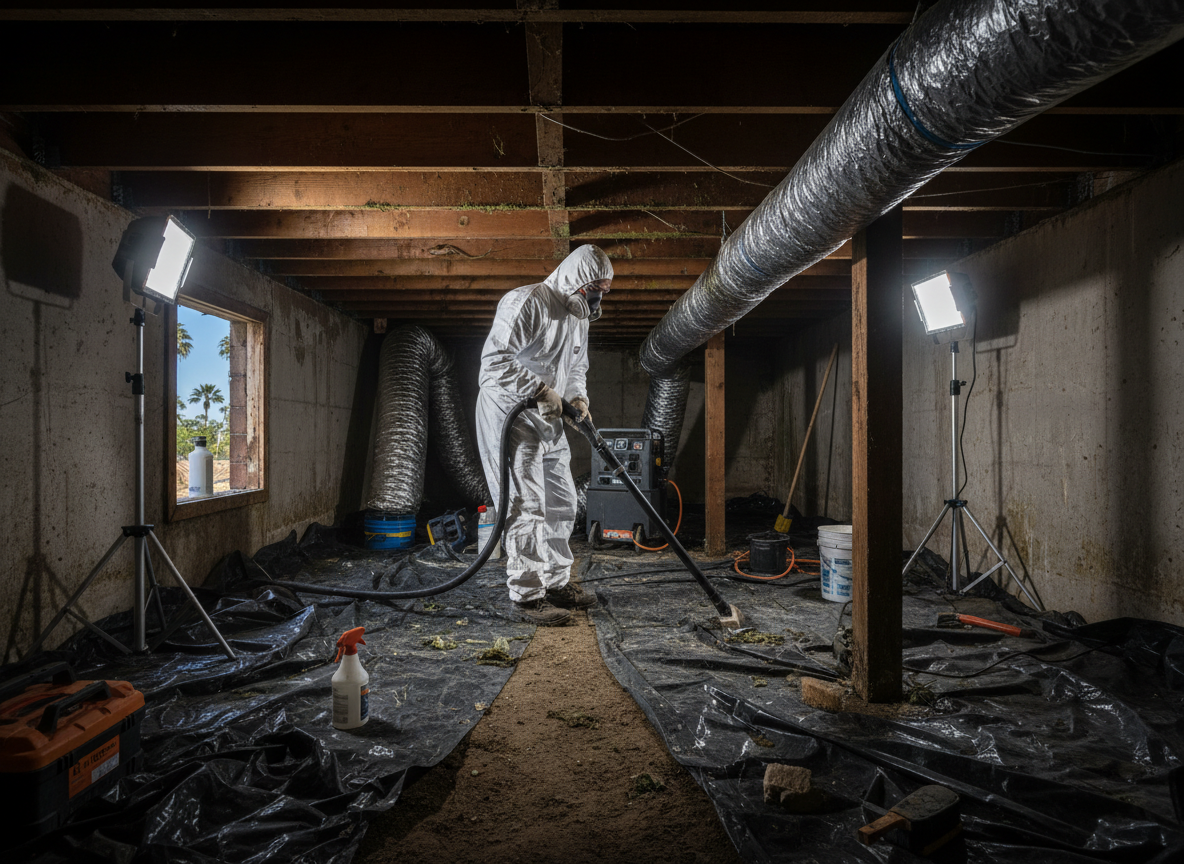
Del Mar homes in Del Mar Heights and North Beach often sit on raised foundations with crawl spaces that trap moisture from the year-round coastal climate. Salt-laden air from Del Mar Beach accelerates corrosion on ductwork and insulation while mild temperatures prevent natural drying. Older stock built before the 1990s frequently lacks vapor barriers, allowing condensation to form on joists and create hidden mold colonies that migrate into living areas through floor registers.
Technicians must account for the sandy, well-drained soil beneath Del Mar Village that still holds humidity close to the ground after winter rains. Access is often limited by low clearances and proximity to Del Mar Racetrack utilities, requiring careful containment to avoid disturbing nearby properties. Powerhouse Park-area homes show repeated issues where irrigation runoff meets the crawl space perimeter, feeding mold on sill plates that standard attic fans cannot reach.
Removal protocols include negative-air machines exhausting toward the ocean breeze direction to prevent re-entrainment, followed by antimicrobial application on treated wood. Encapsulation with heavy-duty liners is common after remediation because the mild climate keeps relative humidity elevated even in summer. Homeowners in Solana Beach and Encinitas border zones face the same conditions and often discover the mold only after musty odors reach first-floor bedrooms.
Seasonal Moisture Patterns
Mold growth peaks after December through February rains when ground saturation combines with cool nights. Spring fog events common near the racetrack keep crawl spaces damp long after surface streets dry. Late summer Santa Ana winds can mask the problem until fall humidity returns.
Technician insight
In Del Mar, the thing that catches most people out with crawl space mold removal is the salt air from Del Mar Beach corroding metal ducts in pre-1980 homes in Del Mar Village while the mild climate keeps the wood just damp enough for mold to return within two seasons if no liner goes down.
North Beach Home After Winter Rain
Homeowner in North Beach noticed musty smell in master bedroom after January rains. Inspection found black growth on joists and saturated insulation near the Powerhouse Park side of the foundation. Crew contained the space, removed wet materials, treated the wood, and installed a sealed liner. Odors disappeared and follow-up sampling showed levels equal to outdoor air.
How it works
- 1
Initial Assessment
Technician enters the crawl space from the exterior access in Del Mar Heights homes, mapping moisture readings on joists and checking for standing water near the foundation.
- 2
Containment Setup
Plastic sheeting and negative air are installed to isolate the space from the living area before any disturbance begins.
- 3
Mold Removal
Affected insulation and surface growth are removed, followed by HEPA vacuuming and treatment of exposed wood members.
- 4
Drying and Encapsulation
Dehumidifiers run until wood moisture drops below 12 percent, then a sealed liner is installed across the dirt floor and walls.
- 5
Final Clearance
Independent air sampling confirms spore levels match outdoor baselines before the space is returned to service.
Pricing
Pricing varies with crawl space size, depth of mold, and whether encapsulation is added; upfront quotes provided after inspection.